Newton's 3rd Law Newton’s 3rd Law of Motion states that, “For every action there is equal and opposite re-action.” (TeacherTech) What this means is that every force has an equal reaction force, but in an opposite direction. Every time an object pushes another object, it gets pushed back in the opposite direction equally hard. So applying this to tennis, when serving you apply force to the ground and the ground pushes back with equal force and in the opposite direction. The 3rd Law helps explain the opposite force on a tennis ball, and that opposite force is the tennis ball’s mass. The ball’s mass helps resists acceleration, and also air resistance. When volleying in tennis, you push off force from the ground with your foot. You push at an angle in to the ground in one direction, and your body goes in the opposite direction, at an angle away from the ground. The force you used to push in to the ground is the force in which you are propelled forward. Another example in serving takes place when a player pushes upward with his or her legs, hips and torso and starts to swing his or her arm toward the tennis ball, the opposite hand decelerates when it comes across the torso, which, in turn, causes the swinging arm to accelerate. Also, when you use one hand to hit a backhand slice, your torso will start to rotate in the direction of the swing and, as the opposite arm stops and begins moving backward, the torso slows vastly, causing the swinging arm to accelerate. (As shown in Figure 1) This is the action and reaction law, Newton’s 3rd Law. That was several ways of how Newton’s 3rd Law relates to Tennis. Now let’s compare how the Physics concept Direction also impacts Tennis. |
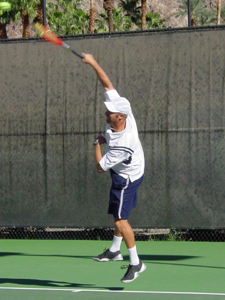 Figure 1 |
